Wednesday, August 17, 2005

Interactive 3D Display: Its Here!


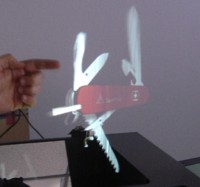
Originally mentioned at Gizmodo as a prototype in 2003, IO2 Technology has just completed the production unit and provided the details behind the revolutionary HelioDisplay which produces interactive 3D dsiplays in thin air (via lasers) from common sources.

The HelioDisplay technology page lists some of its remarkable features:

  • Inputs from most regular sources: PC,TV, DVD, HDTV, Video game consoles
  • Projects a 22″ to 42″ (depending on model) diagonal image that floats above the device
  • It is interactive, like a virtual touch screen: a hand or finger can act as a mouse
  • Although the HelioDisplay uses lasers, the images are not holographic
  • Possible uses for this product include advertising, entertainment facilities, design prototyping, teleconferencing etc. Obviously the applications for such a product are endless. Most importantly it may convince my wife to finally allow the purchase of the Brooke Burke Swimsuit calendar for testing purposes! This of course relies heavily on pricing (TBD) and other more, um, personal matters.

    Apparently the product is ready for release; visit the product page here which looks like its being updated right now.

    Visit the IO2TECHNOLOGY company homepage here.

    Carbon Nanotube Gecko Grippers

    Geckos have an impressive capacity to walk upside down on almost any surface, using just the attractive forces created by their feet to hold on. With this in mind, scientists have attempted to copy the structure of gecko feet to create strongly adhesive materials. The latest version, developed at the University of Akron and Rensselaer Polytechnic Institute, US, uses multiwalled carbon nanotubes attached to a polymer backing.

    More

    Crocodile's Immune System Kills HIV

    In an ongoing effort to stop the spread of HIV, scientists in Australia have discovered that crocodiles can fight off HIV and kill the virus. This is a major boon to medicine because the crocodile serum can also fight things that are penicillin resistant such as staphylococcus aureus.

    Tuesday, August 16, 2005

    U.S. Okays Virgin Galactic Plans

    Space.com reports that the U.S. Department of State's Directorate of Defense Trade Controls has approved collaboration of technical details between Scaled Composites of Mojave, California and Virgin Galactic of the United Kingdom to build passenger-carrying suborbital spaceliners. The next suborbital ship will be a nine person vessel." From the article: "Details about the new company were unveiled at the Experimental Aircraft Association's (EAA) AirVenture air show held July 25-31 in Oshkosh, Wisconsin. The Spaceship Company will build a fleet of commercial suborbital spaceships and launch aircraft. Scaled Composites is to be under contract for research and development testing, as well as certification of a 9-person SpaceShipTwo (SS2) design, and a White Knight Two (WK2) mothership to be called Eve.

    Lab-grown meat "feasible"

    An international research team says that it's possible to mass produce lab-grown meat using today's technology.

    According to BBC News, the researchers say that advances in tissue engineering mean that cells from animals could now be directly grown into meat in the lab.

    "In the long term, this is a very feasible idea," says research team member Jason Matheny of the University of Maryland.

    In order to mass produce meat, Matheny and colleagues suggest growing animal cells on large sheets that are stretched to provide simulated exercise for growing muscles.

    Otherwise, says Matheny, the meat would be mush.

    In a commentary (PDF) in the journal Tissue Engineering, Matheny and colleagues note the following benefits of lab-grown meat:

    With cultured meat, the ratio of saturated to polyunsaturated fatty acids could be better controlled; the incidence of foodborne disease could be significantly reduced; and resources could be used more efficiently, as biological structures required for locomotion and reproduction would not have to be grown or supported.

    Monday, August 15, 2005

    Review of Goals and Plans for NASA's Space and Earth Sciences

    "The main sources of gaps and potential missed opportunities in some roadmaps are a shortage of scientific justification for their stated goals and an overly narrow interpretation of the presidential vision by the NASA roadmap teams."

    More

    Analogical Reasoning in Machines

    Identifying pairs of words that are analogous is easy for humans. For example, most of us can easily understand that the words cat:meow are analogous to dog:bark. Our ability to identify the relational similarity between simple pairs of words is thought to underly many cognitive and linguistic processes. A new paper by Peter D. Turney titled Measuring Semantic Similarity by Latent Relational Analysis (PDF format), describes an algorithm called, you guessed it, Latent Relational Analysis (LRA) that can give machines the ability to measure the relational similarity of words. The algorithm uses a vector space model (VSM) in which words are represented by vectors determined by the frequencies of patterns. The similarity of words is calculated from the cosine of the angle between two word's vectors. The new algorithm was able to achieve human-level performance on analogy questions from a college-level multiple-choice test. For more information see the author's website.

    Friday, August 12, 2005

    Giant virus holds antiaging secrets

    A virus with a huge genome produces a compound that could be used in antiaging treatments.

    Called Emiliania huxleyi virus 86, the virus infects chalk-covered marine algae and uses the compound to slow down its host's aging process.

    Researchers at the Plymouth Marine Laboratory and the Wellcome Trust Sanger Institute in Cambridge have now decoded the virus's genome.

    They discovered a cluster of genes responsible for producing ceramide, a key component of anti-wrinkle and antiaging creams that can control mechanisms leading to programmed cell death. The genes have only previously been found in animal and plant cells.

    "For an invading virus, the ability to control when your host will die and ensure your own survival is quite incredible," says researcher Willie Wilson in a news release. "Essentially the virus hijacks the cell and slows down the aging process by keeping it healthy for as long as possible. It uses the cell as a kind of factory to replicate itself and eventually takes over completely, killing off the cell."

    The genome of the virus comprises 407,000 letters of genetic code, giving it almost as many as the simple celled organism Mycoplasma.

    The discovery of viral ceramide could be a boon for scientists and industries looking for new sources for medicines and cosmetics.

    The research is reported in the journal Science.

    NASA Mars orbiter launches

    NASA's Mars Reconnaissance Orbiter has been successfully launched.

    The orbiter's mission is to see if long-standing bodies of water ever existed on Mars. This could help determine whether the planet ever had water long enough to provide a habitat for life.

    The spacecraft launched from Cape Canaveral Air Force Station in Florida at 7:43 AM EDT morning aboard NASA's first Atlas V rocket.

    The US space agency reports that it is healthy, performing as designed, communicating with ground stations and unfurling its solar arrays.

    The spacecraft now begins a seven-month journey to Mars, followed by six months of refining its orbit.

    The launch follows two failed attempts. Yesterday's attempt was abandoned because of a fuel sensor problem and Wednesday's was cancelled following concerns over the failure of a gyroscope of the type used in the Atlas V.

    Thursday, August 11, 2005

    The 10th planet

    Zecharia Sitchin Responds:"The announcement, on July 30th 2005, that a new celestial body has been discovered made media news around the world; and because the reports were headlined “Astronomers Claim Discovery of 10th Planet,” my phone started to constantly ring… Some callers shouted “Congratulations!”; others, more cautiously, asked: “Is it Nibiru?” – “Nibiru” being the planet of which I had been writing and talking ever since my book The 12th Planet was published decades ago."

    More

    Safer And Guilt-Free Nano Foods

    Over the past few years, nanotech has rapidly become a significant ingredient in the food industry, in applications ranging from smart packaging to interactive foods. Virtually every major food company is involved in nanotech R&D, and the first wave of products is now hitting the market. This is only the beginning, and it's clear that this is an area where nanotech is going to take hold in a big way.

    More

    LG Roboking V-R4000 Floor Vacuum Robot

    LG has recently launched a floor vacuum robot similar to the iRobot Roomba called Roboking in Korea.

    Outside of Korea the LG floorvac robot is dubbed LG V-R4000 (product page).
    Korean Popco has published a review of the LG Roboking floorvac with many photos. Out of some reason they published the story text as image, making it impossible to translate automatically. Still worth to visit for the images.

    Wednesday, August 10, 2005

    NASA NEO News: Deflection Scenarios for Apophis

    Following is an unusually long and technical edition of NEO News. The subject is the deflection options for Apophis (MN4) as described in a new analysis by Donald Gennery, who has kindly made this draft available to NEO News.

    More

    Mars Reconnaissance Orbiter Launch Postponed

    Launch of the Mars Reconnaissance Orbiter (MRO) has been postponed by at least one day. At present, liftoff is scheduled for no earlier than 7:50 a.m. on August 11.

    More

    Tuesday, August 09, 2005

    One 'cure all' flu jab for life

    Scientists are making a vaccine that could give lifelong protection against all types of flu in a single jab.

    More

    Bacteria Used to Create Nanowires

    Derek Lovley and his colleagues of the University of Massachusetts discovered that the Geobacter bacteria is capable of producing nanowires. The bacteria is normally used to clean up toxic waste. Geobacter does not use oxygen, but metal as its source for power. This probably explains the 3nm to 5nm nanowires it excretes while working. What metal the nanowires are made of is not yet known, but the genetic code responsible for their creation is. This opens up the possibility of modifying the bacteria to create nanowires on chips."

    CMU Delivers Gladiator Robot to Marines

    Roland Piquepaille writes "Two years ago, I told you that the Gladiator Robot will join the Marine Corps. Now, the Pittsburgh Post-Gazette reports that the six-wheeled combat robot, designed and developed at Carnegie Mellon University (CMU), made its debut last week. This new U.S. unmanned fighting vehicle can fire machine guns, nonlethal sting balls or tear gas. It could be used for reconnaissance, surveillance and direct-fire missions. CMU will deliver six prototypes of the three-ton robots by 2007 to the Marine Corps, which could deploy about 200 Gladiator vehicles in combat zones around 2009 if the prototypes work as intended. Each Gladiator should cost between $300,000 and $400,000." For more details see Roland's blog.

    Long Live AI.

    "On My Mind" by Ray Kurzweil. Forbes.com. "Many people think the so-called AI winter in the 1980s, when many AI companies folded, was the end of the story. But boom-bust cycles are sometimes harbingers of true revolutions (recall the railroad frenzy of the 19th century), and we see the same phenomenon in AI. Artificial intelligence permeates our economy. It's what I define as 'narrow' AI: machine intelligence that equals or exceeds human intelligence for specific tasks. ... AI programs diagnose heart disease, fly and land airplanes, guide autonomous weapons, make automated investment decisions for a trillion dollars' worth of funds and guide industrial processes. ... So what are the prospects for 'strong' AI, which I describe as machine intelligence with the full range of human intelligence? ... To understand the principles of human intelligence we need to reverse-engineer the human brain. ... The killer app of strong AI, combined with nanotechnology, will be blood-cell-size robots called nanobots. We'll have billions of them traveling in our bloodstream...."

    More

    NASA's Next Leap in Mars Exploration Ready for Launch

    NASA's Mars Reconnaissance Orbiter (MRO) is ready for a morning launch on Wednesday, Aug. 10. The MRO will arrive at Mars in March 2006 for a mission to understand the planet's water riddles and to advance the exploration of the mysterious red planet.

    ° Full Story

    Space Shuttle Discovery Lands in California

    Space Shuttle Discovery touched down this morning at Edwards Air Force Base in California to successfully conclude STS-114. This was the first Shuttle mission to fly since the loss of Space Shuttle Columbia and the STS-107 crew on Feb. 1, 2003.

    More